
SHV Box Hill Clinic
Mon-Fri 9am-5pm
901 Whitehorse Road Box Hill VIC 3128
SHV Melbourne Clinic
Mon-Fri 9am-5pm
Level 1, 94 Elizabeth Street Melbourne VIC 3000
shvic.org.au
1800 013 952

Tubal ligation is a minor surgical procedure which blocks the two fallopian tubes with small clips. Fallopian tubes are the pathway for the egg to enter the uterus. This method of contraception is sometimes also called sterilisation or “having your tubes tied”.
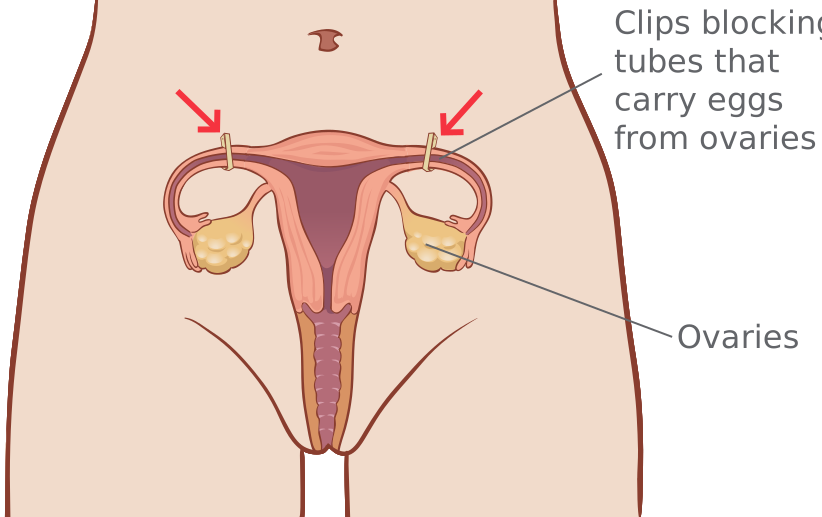
Illustration of tubal ligation
A small incision (cut) is made in the skin around the belly button or lower abdomen and keyhole surgery (known as laparoscopy) is used to place clips on the fallopian tubes or remove the fallopian tubes. Your gynaecologist will discuss keyhole surgery with you.
You will need a general anaesthetic . You can usually go home the same day, but sometimes have to stay in hospital over night.
Tubal ligation is over 99% effective at preventing pregnancy. It is considered to last forever (permanent).
For pregnancy to occur, sperm must fertilise a mature egg. During each menstrual cycle a mature egg is released from one of the ovaries, this is called ovulation. The released egg is funnelled into the fallopian tube and towards the uterus. Tubal ligation blocks the fallopian tubes, stopping the egg from moving through the fallopian tube to the uterus. This prevents pregnancy by stopping sperm from meeting the egg.
Tubal ligation is effective immediately, however pain, discomfort and bleeding following the procedure may mean you do not feel like sex.
You can get a tubal ligation done by a gynaecologist in a hospital or day surgery. You will need a referral from your doctor.
It is very uncommon for a tubal ligation to stop working.
There can be damage to blood vessels, bladder or bowel through surgery, but this is rare.
You are more likely to want a tubal ligation reversed if you:
Although unlikely, if you get pregnant after a tubal ligation, you have an increased risk of ectopic pregnancy. This is a pregnancy that develops outside the uterus, usually in one of the fallopian tubes. An ectopic pregnancy can be an emergency. If you think you are pregnant you should seek medical care as soon as possible.
You can have a tubal ligation at the time of giving birth or shortly after. Speak to your doctor or nurse for more information.
You can reverse a tubal ligation, but it can be expensive. You have around a 50% chance of getting pregnant after reversal.
If you are using the internet for information, only use reliable and reputable websites, such as the ones provided above.
Disclaimer
This website and any related materials are for general information purposes only and should not be relied on as (or in substitution for) medical or other professional advice. You should seek specific medical or professional advice for your individual circumstances.
Copyright ©
The copyright for material on this website is owned by Sexual Health Victoria (or, in some cases, by third parties) and is subject to the Copyright Act 1968. We permit you to reproduce or communicate our copyright material if you are a not-for-profit educational organisation, for the purpose of providing the information to your students provided that you include any disclaimers associated with that material. Any other reproduction or communication of our material requires our prior consent, via our consent form which you can complete and submit.
Last updated: 24 June 2021
Sexual Health Victoria acknowledges the Aboriginal and Torres Strait Islander people as the Traditional Owners of the land on which our offices stand and in the regions in which we provide our services. We pay our respects to Elders past and present.
Sexual Health Victoria strives to provide a welcoming and inclusive environment where all individuals feel accepted, safe, affirmed, celebrated and included.
We value our community and the individuals we serve and work with and we are committed to continuous improvement that provides a culture that celebrates and respects diversity of age, gender, physical abilities, disability, nationality, cultural background and ethnicity, marital, family or relationship status, religious beliefs, sexual orientation and gender identity.


Copyright © 2025 Sexual Health Victoria. All rights reserved.